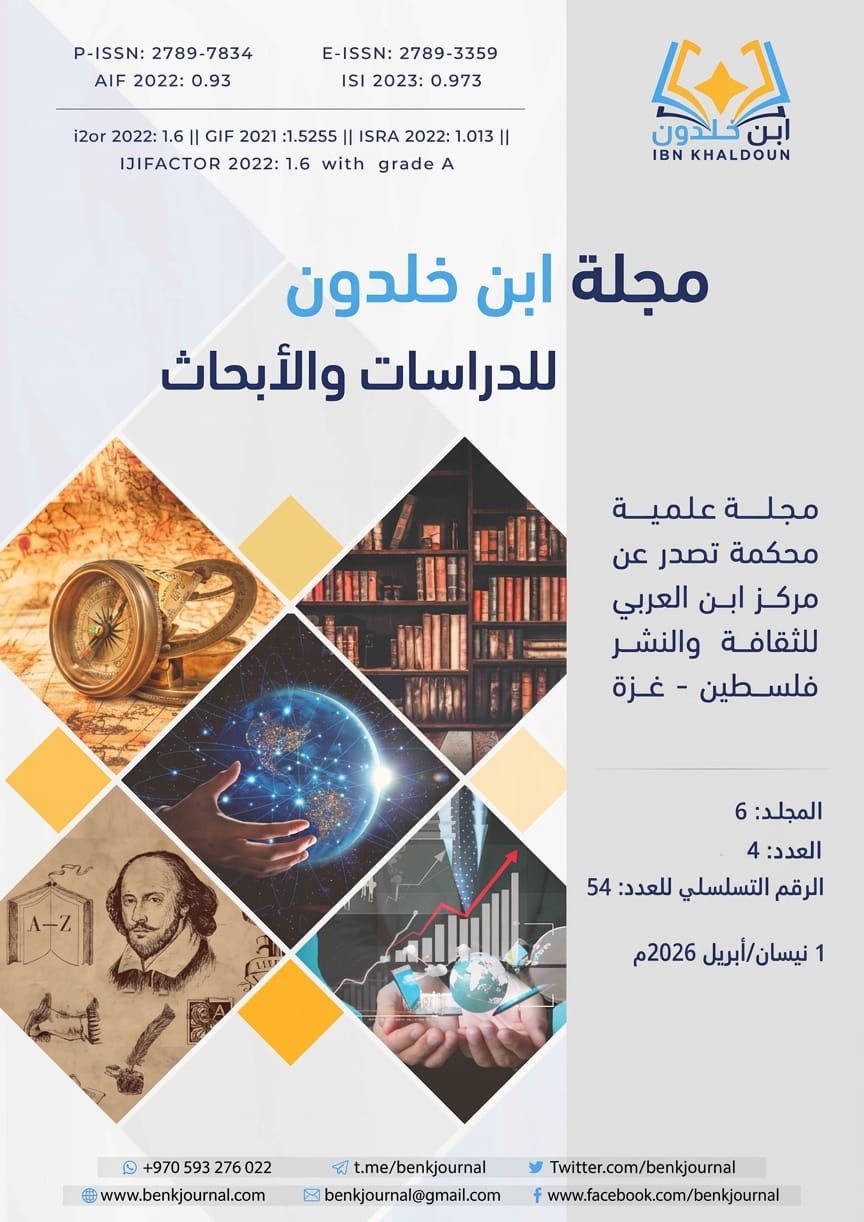
الحقول الدلالية في ديوان السيد سليمان الكبير (ت: 1211هـ): أَلفاظ سكن الإِنسان أَنموذجاً
DOI:
https://doi.org/10.56989/teb3jp62Keywords:
Dwelling terms, semantic field, Diwan of Al-Sayyid Sulayman, ruin and destruction, departure, lexical collocations, contextual meaningAbstract
This study examines the semantic field of terms related to human dwelling and habitation in the Diwan of Al-Sayyid Sulayman al-Kabir (d. 1211 AH), along with the associated meanings of ruin, destruction, and departure. It is based on the analysis of selected poetic excerpts that clearly represent these terms within their various contexts. The study is divided into two main fields: the first includes terms of dwelling and their related notions of ruin and destruction, while the second addresses terms of departure. It also focuses on identifying semantic relationships and exploring the suggestive meanings embedded in poetic language, highlighting the role of context in shaping and diversifying meaning. The findings reveal the prominence of the term “dar” (home) due to its capacity to encompass both Bedouin and urban connotations, as well as the poet’s blending of rural and urban vocabulary. The study also shows his اهتمام (interest) in morphological variations, the expansion of meanings through lexical collocations, and the use of figurative language to express psychological and religious dimensions. Additionally, it demonstrates that semantic fields are not static but capable of branching into interconnected subfields.
References
Published
Issue
Section
License
Copyright (c) 2026 Ibn Khaldoun Journal for Studies and Researches

This work is licensed under a Creative Commons Attribution-NonCommercial 4.0 International License.